
Prilled Urea vs Granular Urea: Which Should You Import?
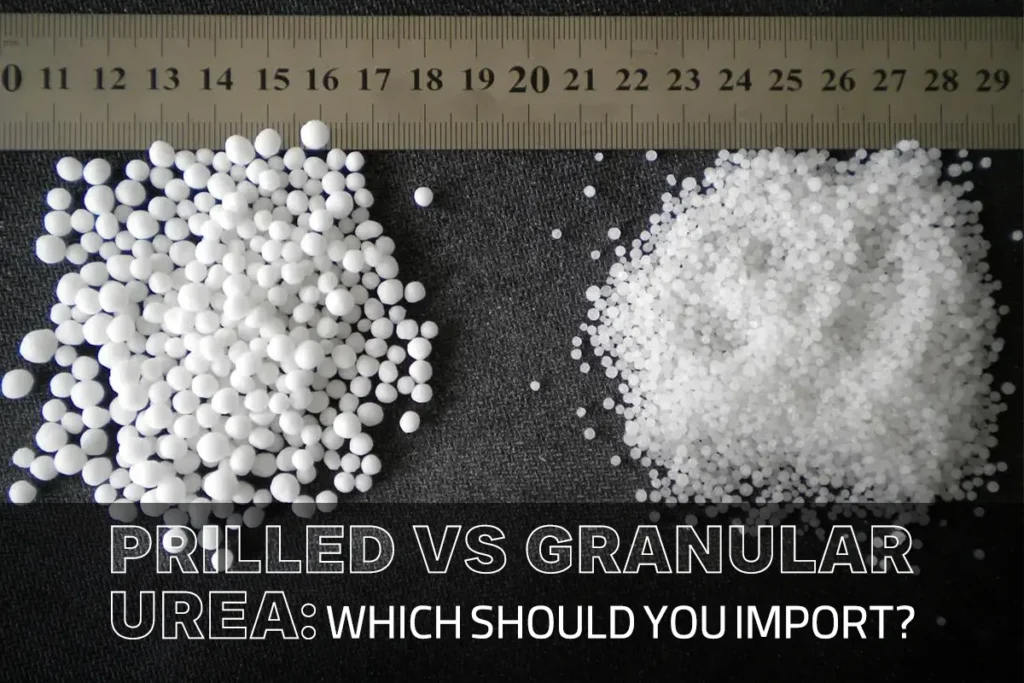
Urea remains one of the world’s most widely traded nitrogen fertilizers, widely used in agriculture and industrial applications due to its high nitrogen content and cost efficiency. Most international buyers encounter two common forms when sourcing bulk urea: prilled urea and granular urea.
Although both products contain approximately 46% nitrogen, their physical characteristics, handling performance, and application suitability can differ significantly. Choosing the right type can affect transportation efficiency, storage stability, application methods, and ultimately overall procurement costs.
In this article, we compare prilled and granular urea to help importers, distributors, and industrial buyers determine which option best fits their market and operational requirements.
What Is Prilled Urea?
Prilled urea is produced through a process in which molten urea is sprayed from the top of a prilling tower, forming small spherical particles as it cools.
Main characteristics of prilled urea:
- Smaller particle size
- Smooth and uniform appearance
- Faster dissolution rate
- Lower crushing strength compared to granular urea
- Commonly used in fertigation and liquid blending systems
Prilled urea is widely traded globally and is often preferred in markets where rapid solubility is important.
Read More: Prilled Urea
What Is Granular Urea?
Granular urea is manufactured using granulation technology that produces larger and harder particles.
Main characteristics of granular urea:
- Larger particle size
- Higher mechanical strength
- Better resistance to moisture and caking
- Improved handling during transportation and storage
- Suitable for bulk mechanical spreading
Granular urea is often favored for large-scale agricultural distribution because of its durability and ease of handling during long-distance logistics.
Read More: Granular Urea
Key Differences Between Prilled and Granular Urea
| Feature | Prilled Urea | Granular Urea |
|---|---|---|
| Particle Size | Smaller | Larger |
| Physical Strength | Lower | Higher |
| Dust Formation | Higher | Lower |
| Solubility | Faster | Moderate |
| Storage Stability | Moderate | Better |
| Bulk Handling | Less resistant | More resistant |
| Mechanical Spreading | Less ideal | More suitable |
| Transportation Durability | Moderate | Excellent |
Which Type Is Better for Import?
The answer depends on your target market, climate conditions, logistics infrastructure, and customer needs.
When Prilled Urea Is the Better Choice
Prilled urea may be the right option if:
- Your market uses fertigation or liquid fertilizer systems
- Fast dissolution is important
- Buyers prefer fine-particle fertilizer
- Distribution distances are shorter
- Budget sensitivity is a key concern
Prilled urea is commonly selected in regions where irrigation-based agriculture is widespread and rapid nutrient absorption is preferred.
When Granular Urea Is the Better Choice
Granular urea is usually preferred when:
- Products travel long export distances
- Storage conditions are humid or challenging
- Buyers use mechanical spreaders
- Bulk handling efficiency is important
- Reduced dust and caking are priorities
For international distributors and large agricultural operations, granular urea often provides better logistical performance and reduced product loss during transport.
Climate and Storage Considerations
Climate conditions can strongly influence which urea type performs better after import.
Humid climates
Granular urea generally performs better because of:
- Higher crushing strength
- Lower moisture absorption
- Reduced caking risk
Dry climates
Both products can perform effectively if stored properly.
Long-term storage
Granular urea is usually more stable during extended warehousing and international shipping operations.
Transportation and Export Efficiency
From an export perspective, handling characteristics matter significantly.
Granular urea is often preferred for:
- Bulk vessel shipments
- Long container transport routes
- High-volume industrial distribution
Its larger and harder particles reduce breakage and dust generation during loading and unloading operations.
Prilled urea, however, can still be highly effective for markets with established handling systems and strong demand for fast-soluble fertilizers.
Cost Considerations
Pricing differences between prilled and granular urea can vary depending on:
- Manufacturing region
- Supply-demand conditions
- Freight costs
- Packaging method
- Seasonal agricultural demand
In some markets, prilled urea may offer a lower purchase price, while granular urea may reduce operational losses and handling costs over time.
Smart buyers evaluate not only the product price per ton, but also factors such as transportation efficiency, product durability, storage performance, and the final application requirements. Considering these elements together helps importers reduce operational costs, minimize product loss, and ensure better long-term performance throughout the supply chain.
How SAEN Supports International Urea Buyers
At SAEN, we understand that selecting the right urea type is not only a technical decision — it is also a commercial and logistical strategy.
As an international supplier of urea and industrial products, SAEN supports buyers with:
- Reliable sourcing channels
- Consistent product quality
- Competitive export pricing
- Flexible packaging solutions
- International logistics coordination
- Commercial guidance for global markets
Whether you are importing prilled urea for agricultural distribution or granular urea for large-scale industrial and farming operations, our team helps ensure efficient procurement and dependable supply.
Final Thoughts
Both prilled and granular urea offer valuable advantages, but the best choice depends on your operational priorities and market conditions.
In general:
- Choose prilled urea for fast dissolution and fertigation applications
- Choose granular urea for better handling, storage stability, and bulk transportation efficiency
Importers who evaluate logistics, climate, application methods, and end-user requirements carefully can significantly improve supply chain performance and customer satisfaction.
Looking for a Reliable Urea Supplier?
SAEN provides high-quality urea products for international agricultural and industrial markets with dependable sourcing, transparent trade processes, and global export support.
Contact SAEN today to discuss:
- Prilled and granular urea supply
- Bulk export opportunities
- Packaging options
- International shipping solutions
- Competitive pricing for long-term partnerships
Leave a Reply