
Viscosity Grade (VG Table)
In the early 1960s, an improved asphalt grading system was introduced, incorporating a scientifically based viscosity test. The test is conducted at two key temperatures: 60 °C ± 0.3 °C, representing the average road surface temperature under sunshine, and 135 °C, reflecting the average temperature of bitumen during asphalt mixing.

Table of Contents
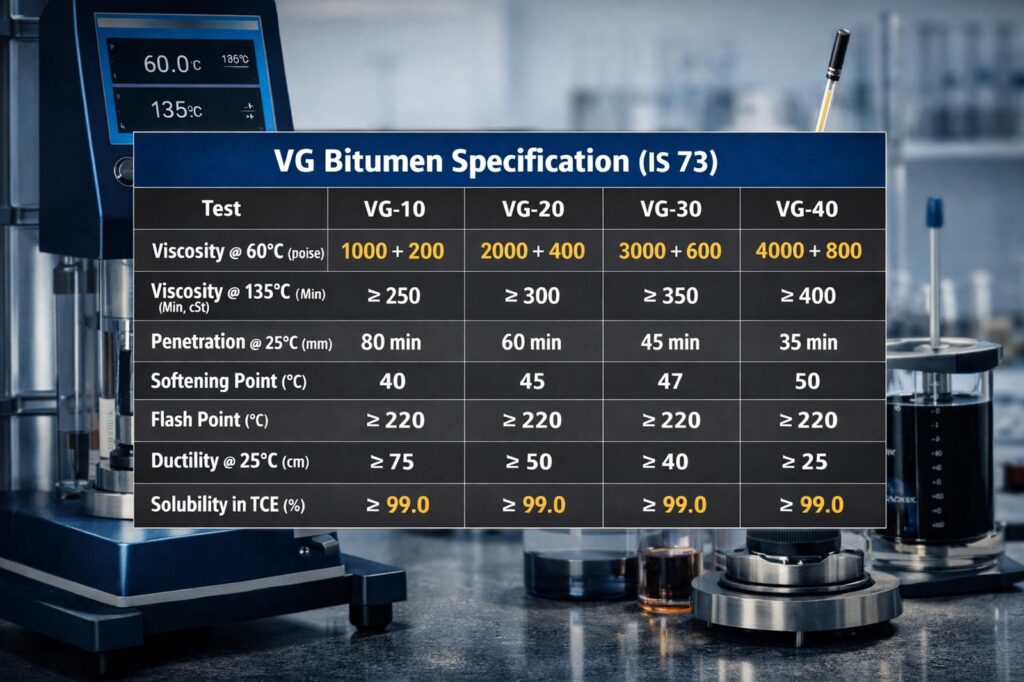
Viscosity Grade (VG) bitumen is classified according to its viscosity characteristics at 60°C and 135°C, as defined by the Indian Standard IS 73. This grading system provides a more performance-based evaluation compared to traditional penetration grading, ensuring better selection for specific climatic and traffic conditions.
Why Viscosity Grading Is Important
Viscosity grading is important because it directly relates laboratory measurements to real field performance. Unlike older grading systems that rely only on penetration depth, VG classification evaluates how bitumen behaves under actual working temperatures.
This matters because pavement failures typically occur due to temperature-related stress and traffic loading. By controlling viscosity at defined temperatures, engineers can:
- Reduce rutting and permanent deformation in hot climates
- Minimize thermal cracking in cooler regions
- Ensure stable mixing and compaction during asphalt production
- Improve long-term pavement durability
- Achieve more consistent quality control in large-scale projects
Why Are 60°C and 135°C Critical?
The viscosity test is performed at two key temperatures to simulate real-world conditions:
- 60°C ± 0.3°C → Represents the average maximum road surface temperature under direct sunlight. This determines resistance to rutting and deformation under traffic loads.
- 135°C → Represents the typical temperature of bitumen during hot mix asphalt production. This ensures proper pumpability, coating of aggregates, and workability during mixing and laying.
By measuring performance at both service and mixing temperatures, VG grading provides a scientifically reliable basis for selecting the correct bitumen grade for specific environmental and traffic conditions.
In hot climates, bitumen with low penetration and high viscosity (e.g., VG40) is used to prevent deformation under high ambient temperatures. Conversely, in cooler regions, bitumen with high penetration and low viscosity (e.g., VG10) is preferred to minimize cracking under freezing conditions.
VG Bitumen Specification Table (IS 73)
Below is the standard specification for VG grades:
| Test | VG-10 | VG-20 | VG-30 | VG-40 |
| Dynamic viscosity @60°C (poise) | 1000 ± 200 | 2000 ± 400 | 3000 ± 600 | 4000 ± 800 |
| Kinematic Viscosity @135°C (Min, Cst) | 250 | 300 | 350 | 400 |
| Penetration, 25°C, 100g 5s, min | 80 | 60 | 45 | 35 |
| Flash Point °C | 220 | 220 | 220 | 220 |
| Softening Point °C | 40 | 45 | 47 | 50 |
| Solubility in Trichloroethylene (min %) | 99.0 | 99.0 | 99.0 | 99.0 |
| Test on residue from Thin Film Oven Test | _ | _ | _ | _ |
| Ductility, 25°C, 5cm/min, cm | 75 | 50 | 40 | 25 |
| Viscosity Ratio @60°C Max | 4.0 | 4.0 | 4.0 | 4.0 |
Applications of Each VG Grade
Selecting the correct viscosity grade is essential for pavement durability and long-term performance. Using the correct VG grade ensures long-lasting pavements, reduces maintenance frequency, and optimizes lifecycle costs. Engineers can predict pavement performance more accurately, resulting in safer roads and lower repair budgets.
🔹 VG-10
- Cold climate regions
- Spray applications
- Surface dressing
- Light traffic roads
🔹 VG-20
- Moderate climate conditions
- Cold mix asphalt
- Rural road construction
🔹 VG-30 (Most Common Grade)
- National highways
- Heavy traffic roads
- Binder and base courses
- Urban road networks
🔹 VG-40
- Areas prone to rutting
- Hot climate regions
- High axle load corridors
- Intersections and bus lanes
Recommended VG Grades by Climate and Traffic
- Cold Regions: VG-10 for low-temperature flexibility and crack resistance
- Moderate Climates: VG-20 for standard rural and low traffic roads
- High-Traffic Roads: VG-30 ensures stability and durability for highways
- Hot Climates & Heavy Loads: VG-40 prevents rutting and deformation under extreme conditions
VG Bitumen into Asphalt Design
Selecting VG bitumen is one part of asphalt design. Engineers must also consider aggregate type, layer thickness, compaction method, and additives like polymer modifiers or fibers to enhance performance under specific traffic and climate conditions.
A recent highway project in southern India used VG-40 bitumen in high-temperature zones. After 5 years, the road showed minimal rutting and no significant cracking, compared to neighboring roads using standard penetration-graded bitumen which required early resurfacing.
For expert advice on selecting the right VG bitumen for your project, contact our technical team today and ensure your pavement performs optimally under all conditions.